
Interactive Map 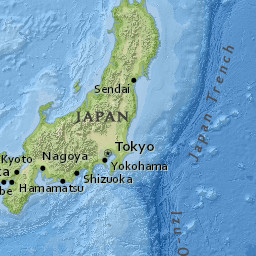

Regional Information 
Felt Report - Tell Us! 000186ResponsesContribute to citizen science. Please tell us about your experience.Did You Feel It?VIII 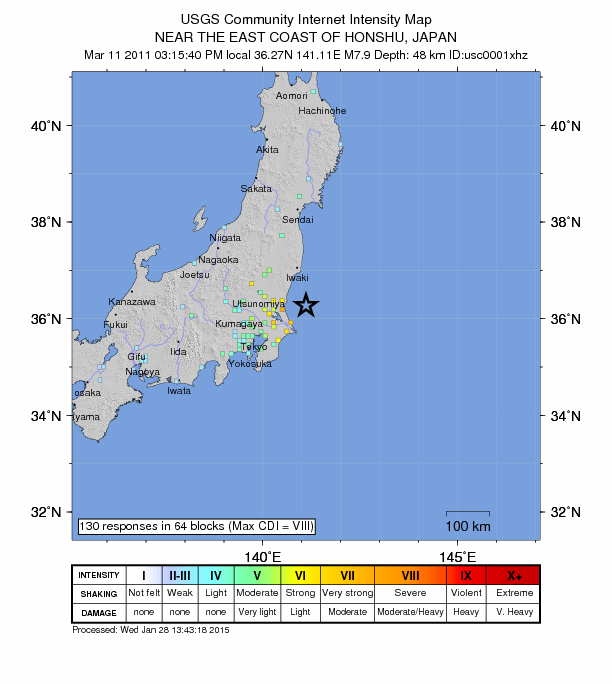
ShakeMapVIII 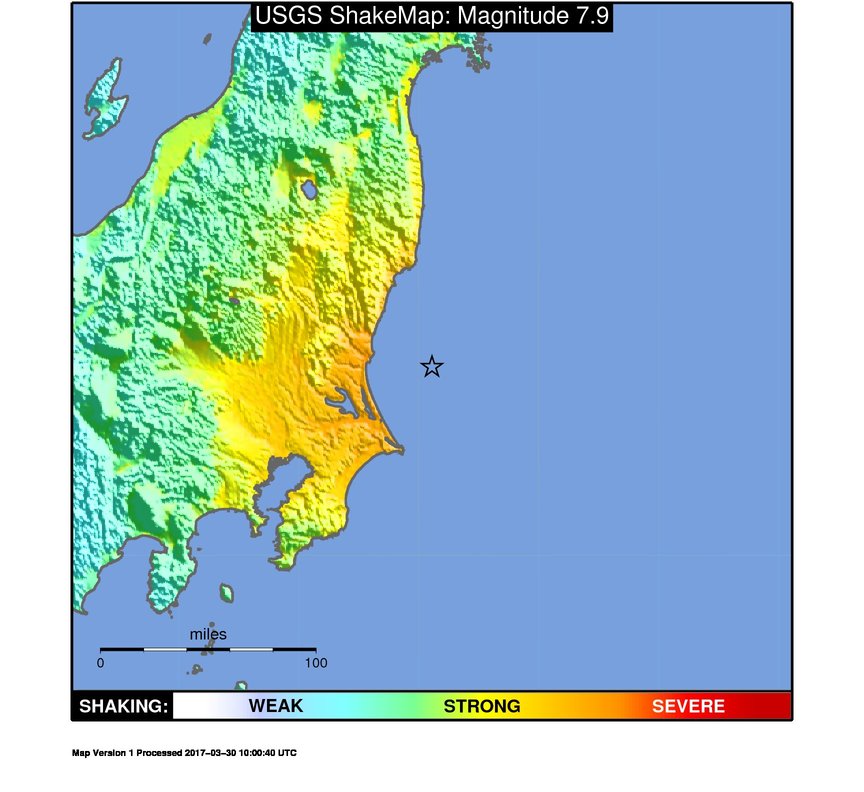
Origin - Review Status
- REVIEWED
- Magnitude
- 7.9 mwc
- Depth
- 42.6 km
- Time
Moment Tensor View Nearby Seismicity 
Time Range
± Three Weeks
Search Radius
250.0 km
Magnitude Range
≥ 4.0
Tectonic Summary
The March 11, 2011, M 7.9 earthquake off the east coast of Honshu, Japan, about 140 km northeast from Tokyo, occurred as a result of shallow thrust faulting on or near the subduction zone plate boundary between the Pacific and North America plates. At the location of this earthquake, the Pacific plate moves roughly westward relative to the North America plate at a velocity of 71 mm/yr and begins its westward descent beneath Japan at the Japan Trench, east of the March 11th earthquake. Note that some authors divide this region into several microplates that together define the relative motions between the larger Pacific, North America and Eurasia plates; these include the Okhotsk and Amur microplates that are part of North America and Eurasia, respectively.
The March 11th M 7.9 earthquake occurred approximately 30 minutes after the devastating March 11, 2011, M 9.1 Tohoku earthquake, and can be considered an aftershock at the southern end of the rupture area of that event. Over the 2 days preceding the March 11th mainshock, a series of large foreshocks had occurred, beginning on March 9 with a M 7.3 event approximately 40 km from the epicenter of the March 11th M 9.1 earthquake, and continuing with another three earthquakes greater than M 6 on the same day. Prior to March 9, the Japan Trench subduction zone had hosted nine events of M 7+ since 1973.
While commonly plotted as points on maps, earthquakes of this size are more appropriately described as slip over a larger fault area. Thrust-faulting events of the size of the March 11, 2011, M 7.9 earthquake are typically about 135x60 km (length x width); interference from the previous M 9.1 event makes modeling its source dimensions complicated, and as such a slip model is not available at this time.
Hayes et al. (2016) Tectonic summaries of magnitude 7 and greater earthquakes from 2000 to 2015, USGS Open-File Report 2016-1192. (5.2 MB PDF)